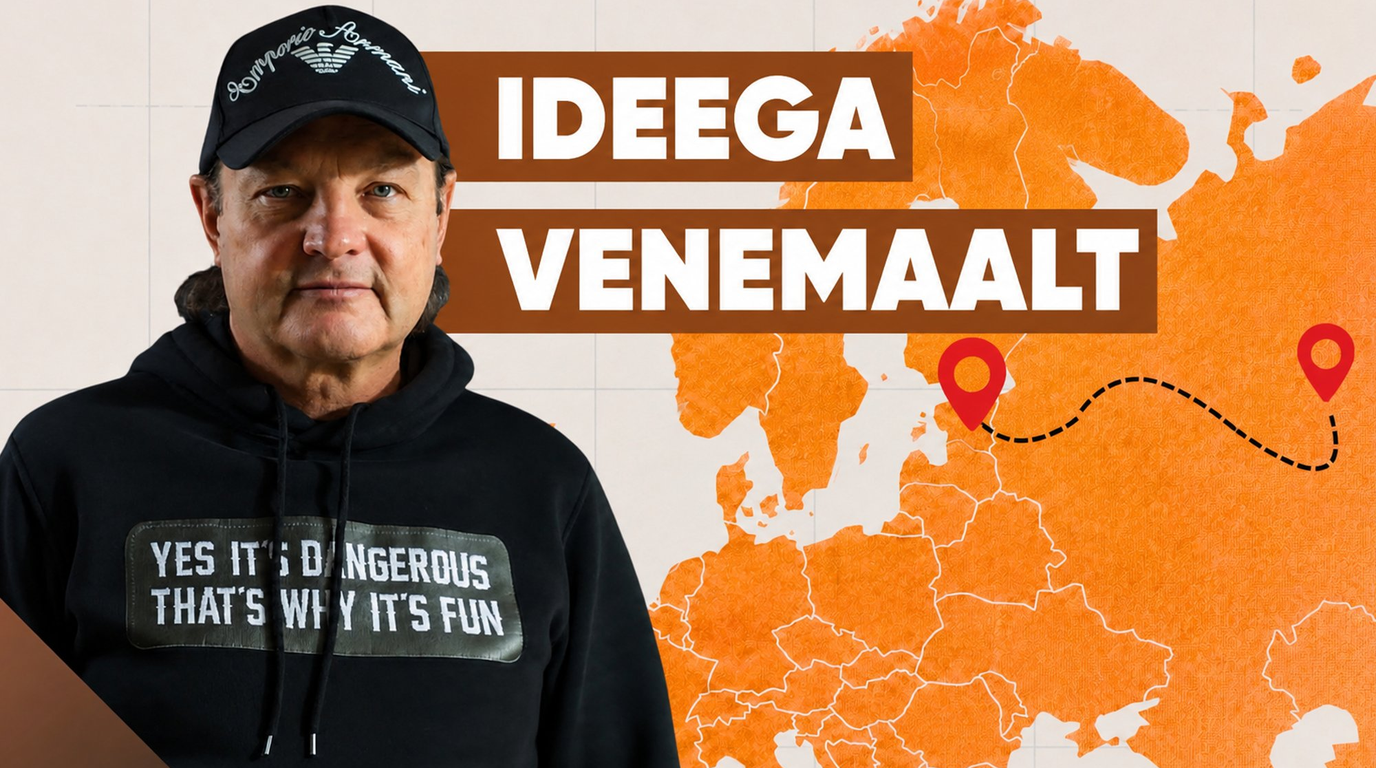
Konstantin Shvarts talks about his life in Tallinn and his current investment projects. The interview is part of the new Delfi series "From Russia with an idea", about entrepreneurs who left for Europe and built their business here.
Konstantin Shvarts asks straight away not to count him among the entrepreneurs who had to escape from Russia.
Estonia, he says, always stayed part of his life: "I was born in Tallinn and finished school here. My parents are Estonian citizens, they have always lived here and of course I visited them. In the early 90s, and then from 2009, I ran business in Estonia."
I sold the bank successfully, then got on a plane and flew to Estonia. I simply came home for good.
A career built in Russia
Before returning to Estonia, Konstantin Shvarts built a serious career in Russian banking. After graduating from the Moscow Institute of Physics and Technology he stayed in Russia, took Russian citizenship and went into business.
In 2000 he acquired the Russian Empils-Bank together with partners, later renamed Rosenergobank, and ran it for many years. At its peak Rosenergobank was among the hundred largest banks in Russia: assets of around one billion dollars and a staff of about 1000 people.
In the mid-2010s the Russian banking sector changed sharply, as Shvarts described earlier in the RusDelfi podcast: "There was a clean-up of the banking sector. Mostly private banks were swept out, because they were a political threat. They could fund the opposition, voice an opinion, shape meaning, start their own movements."
After he refused to sell the bank, between 2015 and 2017 a wave of regulatory inspections began at Rosenergobank: "I understood that we would not hold out, that I would have to sell my own child. We had spent 17 years building that bank, so the feelings were not the most pleasant."
Who is Konstantin Shvarts
- Born in 1966 in Tallinn, graduated from Tallinn Secondary School No 40.
- Graduate of the Moscow Institute of Physics and Technology (MIPT), later graduated with honours from the Financial Academy under the Government of Russia.
- Was already an entrepreneur in Soviet times: in the late 1980s he set up one of the first cooperatives in the Moscow region.
- In 2000, together with partners, acquired Empils-Bank, which was renamed Rosenergobank. By the time of its sale in 2017 the bank was among the hundred largest in Russia, with assets of over 1 billion euros, 27 branches and more than 1000 employees.
- In the 1990s supported the initiatives of deputy prime minister Boris Nemtsov, was connected to the Union of Right Forces party and sponsored the campaigns of opposition politician Boris Nadezhdin.
- Has been doing business in Estonia since 2009. Heads Nordvik Investments, which specialises in investments into startups and technology projects.
Source: Wikipedia
In the end, in 2017, Shvarts sold his stake and left Rosenergobank. After the change of owners the bank lost its licence, and later the Russian authorities opened a criminal case against the former management on fraud charges.
In February 2026 the Basmanny court in Moscow sentenced the former chairman of the board of Rosenergobank, Konstantin Shvarts, in absentia to 11 years in a general regime colony and a fine of several million. The verdict has not entered into force, an appeal has been filed.
The banker himself is convinced that the proceedings initiated by the Russian authorities are political and connected to his views and contacts. Over the years Shvarts was close to the Russian liberal camp: in the 1990s to the initiatives of Boris Nemtsov, later to the Union of Right Forces party.
For many years he also supported the opposition politician Boris Nadezhdin (who has now left Russia as well), was one of his sponsors and helped him financially during elections.
The so-called criminal case was opened in Russia about two years later, when I was already living quietly in Estonia. That is how it goes in Russia if you are close to politics.
"I miss those people and that level of conversation"
The most painful loss after leaving Russia, Shvarts says, is not the change in his usual way of life and not even the sale of Rosenergobank, but the loss of his old circle of friends, acquaintances and colleagues.
I miss those people and the level of conversation with them.
Remembering that circle, Shvarts also speaks about his years at the Moscow Institute of Physics and Technology, which he calls one of the best technical universities of the former USSR. Among his lecturers was the well known physicist Sergei Kapitsa, and among his acquaintances and fellow graduates are financial analyst Stepan Demura, opposition politician Boris Nadezhdin and Revolut founder Nikolay Storonsky.
He does not see the move to Estonia as a step back. The limited size of the Estonian market has not become a problem either, since his investment work mostly goes beyond the country.
Estonia is an open liberal democracy, a very convenient place for international business and investment. In that sense I did not lose, I gained.
On the other hand, in Estonia he clearly misses the density of professional contacts and competition that exists in the big global centres.
"In the big capitals, and that is not only Moscow but also London and New York, there is a huge concentration of talented people and of every kind of specialist and service, all competing for jobs, projects and the future," he explains.
He separately notes the difference in attitude to career and growth: in his view, the Estonian environment is less oriented towards constant competition and towards striving for big achievements.
In general local people are less ambitious and to a large extent happy with what they have.
"I see big risks ahead"
Today his company Nordvik Investments puts money both into listed assets and into promising startups. Among the directions that interest him are fintech, artificial intelligence and biotech.
In Estonia he has taken part in several financial technology projects. Right now he pays particular attention to solutions at the intersection of AI, biology and chemistry, where he believes promising developments may appear.
At the same time he is in no hurry with new investments: "I have taken a pause in investing, because I see big risks ahead."
In his recent columns the entrepreneur points out that the global economy is approaching a period of serious trials.
Among the pressure factors on the markets he lists a possible deterioration in the United States, the high cost of borrowing, the risk of another rise in energy prices, geopolitical instability and signs of overheating around companies linked to artificial intelligence.
Unfortunately, we are talking about a combination of factors that will most likely lead to unpleasant economic consequences.
Does a Russian background get in the way of business?
According to Konstantin Shvarts, experience in Russian business can in some cases become an extra obstacle today. His company, for example, would hardly be able to take part in defence projects in EU countries.
Of course, against the background of everything that is happening, a Russian background theoretically gets in the way.
In finance and investment, however, Shvarts says this creates no additional barriers for him: "Rather the opposite, many partners value my experience and knowledge."
The biggest advantage of life in Estonia today, Konstantin Shvarts believes, is the chance to concentrate on work calmly.
In Tallinn, and in Estonia in general, it is of course safe.
Unlike Moscow, there is far less fuss here, he continues: "For those who never liked endless parties and meetings, there is more room to be with the people close to you and to look after yourself, more freedom and more time for yourself."
Although the projects of Nordvik Investments are aimed first of all at the international market, Shvarts is not planning to tie his future to another country: "Estonia is a convenient place for me and for the goals of my business. I am not planning to move to Dubai or Monaco yet."
Interview by Dmitri Poltavski, web editor. Published on 5 August 2026 in Delfi Ärileht and RusDelfi, series "From Russia with an idea". Photos: Appolinaria Korobitsyna, Konstantin Shvarts / Delfi Meedia.